
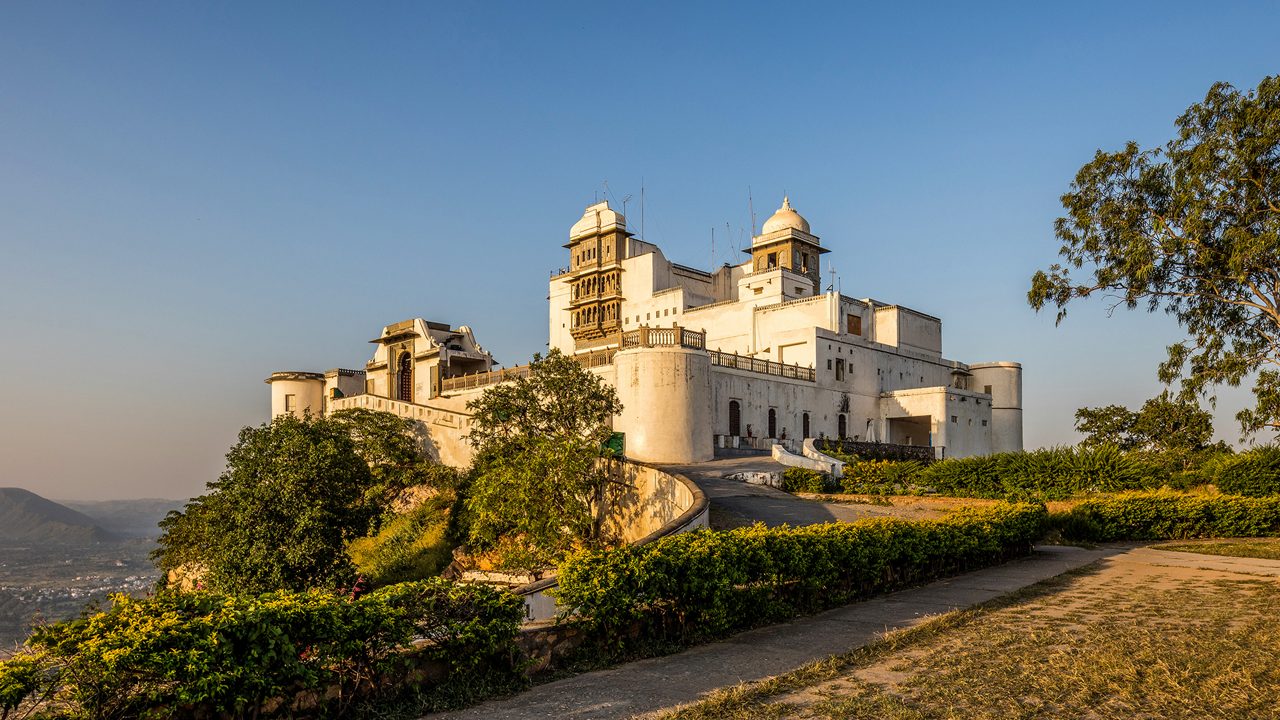
Crowning the Bansdara Peak at 944 meters above sea level, Sajjangarh, popularly known as the Monsoon Palace, is one of Udaipur's most iconic and romantic landmarks. Built in the late nineteenth century by Maharana Sajjan Singh of the Mewar dynasty, this ethereal palace was conceived as a nine-story astronomical and weather observatory cum retreat from where the Maharana could watch the magnificent monsoon clouds roll in over the Aravalli range and the shimmering lakes of his beloved kingdom.
The story of Sajjangarh begins with Maharana Sajjan Singh, who ascended the throne of Mewar in 1874 at the young age of sixteen. Despite his youth, he was a ruler of remarkable vision and refined sensibilities, deeply committed to the development and modernization of his kingdom. Among his many ambitious projects — which included expanding the railway network, improving infrastructure, and restoring lakes — the construction of a grand palace atop the Bansdara Peak was perhaps his most poetic endeavor. He envisioned a hilltop retreat where he could observe the dramatic monsoon weather patterns sweeping across the Aravalli hills and the lake-studded valley of Udaipur.
Construction of the palace commenced around 1874 and continued for nearly a decade. Maharana Sajjan Singh spared no effort in ensuring that the palace would be a masterpiece of Rajput architecture, blending traditional Mewari craftsmanship with modern sensibilities. The site chosen was the highest point in the Aravalli range surrounding Udaipur, offering an unparalleled 360-degree vantage of the entire region. Workers and artisans hauled stone and materials up the steep hillside, constructing a road and a sturdy foundation on the rocky summit. The palace was designed to rise nine stories tall, an ambitious height intended to maximize the panoramic views and serve as a functional weather observatory.
Tragically, Maharana Sajjan Singh's reign was cut short when he died in 1884 at the tender age of just twenty-seven, before the palace could be fully completed. His successor, Maharana Fateh Singh, continued some work on the structure but ultimately chose to focus his resources on other projects within Udaipur. As a result, Sajjangarh remained an unfinished dream — a hauntingly beautiful palace that never realized its full nine-story grandeur, yet still stands as one of the most spectacular monuments to a young ruler's extraordinary vision.
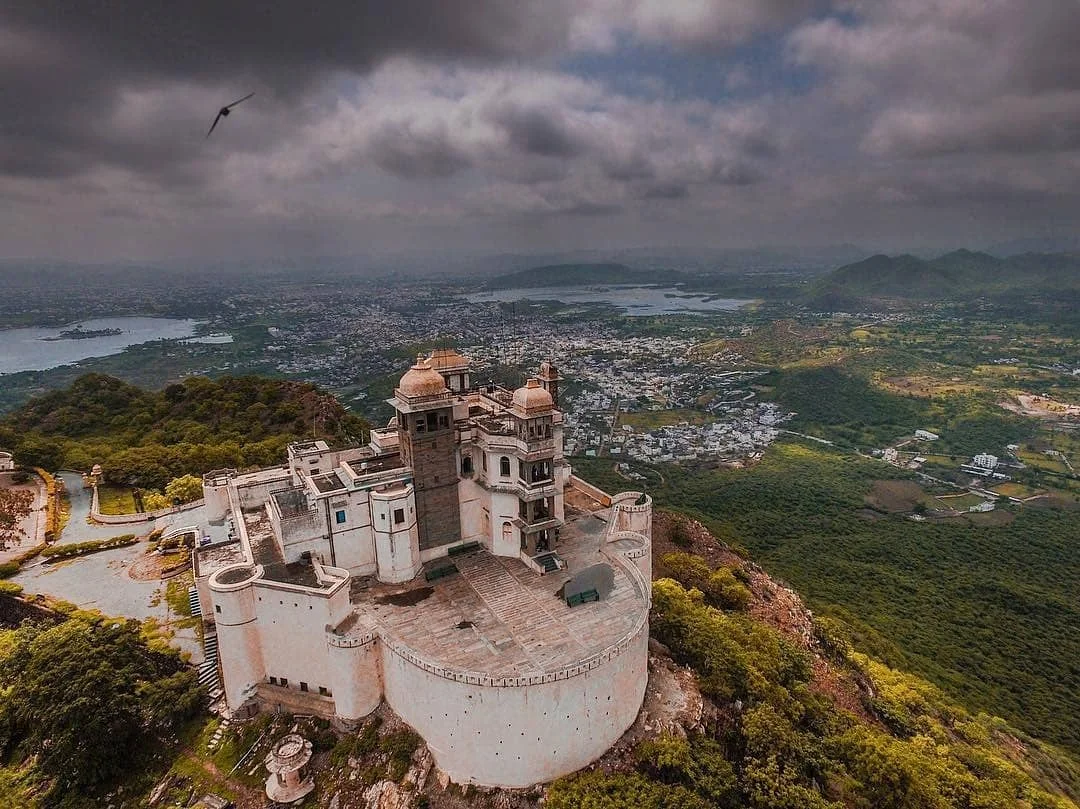
The architecture of Sajjangarh is a splendid expression of Rajput palatial design, characterized by its grand scale, ornate detailing, and seamless integration with the dramatic natural landscape. Built primarily of white marble and local stone, the palace gleams like a crown upon the hilltop, especially when illuminated during the evening hours. Its façades feature a harmonious blend of jharokha balconies, cusped arches, carved chhatris, and intricate stone lattice screens known as jali work — all hallmarks of the refined Mewari architectural tradition that reached its zenith during the reign of the Sisodia dynasty.
The interior of the palace, though never fully completed to its original nine-story plan, still reveals spacious halls and chambers designed for royal comfort and astronomical observation. The central hall was intended to serve as the primary viewing gallery, with large windows and open terraces oriented to capture the shifting patterns of monsoon clouds, star-lit skies, and the interplay of light on the lakes below. The thick stone walls were designed to keep the interiors cool during the blistering Rajasthani summers, while the elevated position ensured a constant breeze that made the palace a natural retreat from the valley heat.
One of the most remarkable architectural features is the palace's sophisticated rainwater harvesting system. A large cistern with a capacity of over 22,000 gallons was constructed within the palace complex to collect and store rainwater, an essential feature given the palace's remote hilltop location. This engineering foresight reflects the deep understanding of water management that has defined Mewar's rulers for centuries, from the legendary construction of Lake Pichola by Maharana Udai Singh to the intricate dam systems built by successive Maharanas to sustain their kingdom in this arid region.

The single greatest draw of Sajjangarh is its breathtaking 360-degree panoramic view, widely regarded as one of the finest vantage points in all of Rajasthan. From the palace terraces, the entire city of Udaipur stretches out below like a miniature painting — the serene waters of Fateh Sagar Lake, Lake Pichola, and Swaroop Sagar Lake glistening in the sunlight, the white marble of City Palace and Jag Mandir reflecting off the water, and the distant silhouettes of the Aravalli hills rolling away to the horizon in every direction. On exceptionally clear days, it is said that one can see as far as the distant ranges of Chittorgarh, the ancestral seat of the Sisodia dynasty.
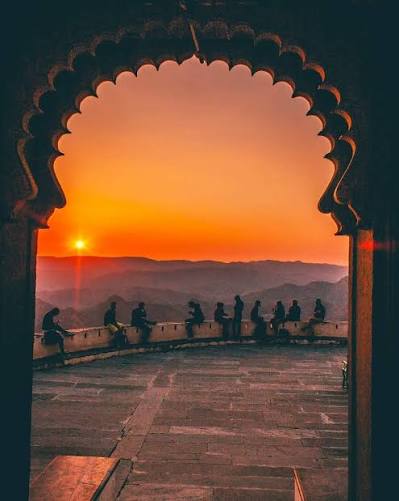
It is at sunset, however, that Sajjangarh truly earns its reputation as one of the most magical places in Udaipur. As the sun descends toward the western Aravalli ridgeline, the sky transforms through an ever-shifting palette of gold, amber, crimson, and violet. The lakes below become mirrors of molten fire, the palace walls glow with warm amber light, and the entire landscape is bathed in a soft golden haze that seems to suspend time itself. Visitors and photographers gather on the terraces each evening to witness this daily spectacle, which has been described as one of the finest sunsets in all of India.
During the monsoon season, from July through September, the palace takes on an altogether different and even more dramatic character. Dark, towering cumulonimbus clouds roll in across the Aravalli range, lightning flickers between the peaks, and rain sweeps across the lakes in visible sheets — a primal display of nature's power that can be watched in safety from the palace balconies. It is precisely this experience that Maharana Sajjan Singh sought when he conceived the Monsoon Palace, and standing here during a monsoon storm, one understands his vision with perfect clarity.
In a fitting transformation that aligns with contemporary conservation values, Sajjangarh and its surrounding hill ranges have been designated as the Sajjangarh Wildlife Sanctuary, managed by the Rajasthan Forest Department. The sanctuary encompasses approximately 5.19 square kilometers of the Aravalli hill ecosystem, protecting a rich biodiversity that includes leopards, jungle cats, hyenas, jackals, wild boars, sambar deer, chital, nilgai, and a variety of reptiles and bird species. The sanctuary's rugged terrain and dense forest cover provide an ideal habitat for these animals, many of which are increasingly rare in the rapidly developing regions surrounding Udaipur.
At the base of the Bansdara Peak, the Sajjangarh Biological Park offers visitors an opportunity to observe some of the region's most iconic wildlife up close in spacious, naturally designed enclosures. The park is particularly renowned for its leopard conservation efforts, providing a safe home for these elusive big cats that once roamed freely throughout the Aravalli range. Other residents include marsh crocodiles basking in specially designed water pools, herds of graceful chital and sambar deer, sloth bears, and wild boar — all housed in enclosures that closely mimic their natural habitat within the sanctuary's forested hills.
A scenic winding road leads from the biological park up through the sanctuary's forested slopes to the palace at the summit, and many visitors choose to make the ascent on foot, enjoying a rewarding trek through the deciduous forest. The walk takes approximately 45 to 60 minutes and offers occasional wildlife sightings along the way — peacocks strutting through the undergrowth, langurs watching from the canopy, and if luck favors, the distant silhouette of a leopard on a rocky outcrop. The combination of a wildlife experience and a heritage monument makes Sajjangarh unique among Udaipur's many attractions.

Stay at Vega and enjoy easy access to the Monsoon Palace along with our curated hilltop sunset experience packages.
Book Your StayGet Insider Tips, Exclusive Member Offers & Travel Inspiration for Udaipur delivered straight to your inbox.